how did the manhattan project improve american military technology
American soldierlike technologies developed during Human beings Warfare Cardinal became more advanced and specialistic as the war progressed. The technologies produced ranged in complexity from relatively simple items such as half-size arms and armored vehicles, including tanks, to more decomposable items such as the microscopical bomb calorimeter. The latter, produced under the secretive Manhattan Project, proved to be an incredibly powerful weapon that revolutionized war and was wont to death the war. Other technologies, much as the M4 Sherman tank car, the M1 Garand and M1 Carbine, and the gas mask, were refinements along previously existing technologies.
Tanks [edit]
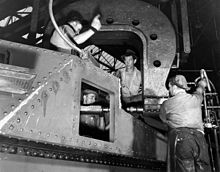
An M3 tank under construction
The M4 Sherman became the normal North American country military tank in World War II.[1] Attributable lack of development before the warfare leading to inexperience in tank design, the first large scale yield of a mass medium tank was the M3 Lee, collective for the U.S.A and the Brits, a via media design with the intense weapon mounted in the hull. Information technology did have a stabilized 37mm gun in the turret, which was effective against antitank guns, capable to fire, and hit, tied when moving. Aside contrast, no German tanks had stabilized guns.
The M6 series was the first of the heavy tanks used during the war. This particular tank series weighed approximately 50 to 80 heaps. Piece there were demand for heavy tanks by some elements within the US Ground forces, opposed views held predominated. Solely one US heavy tank was produced during the war and information technology only reached European Economic Community in the final months.
Likewise As the US Army it was used to equip separate western Allies helping alongside their own designs. Over 50,000 tanks were produced during the time of the war. Tanks like these were used during combat in mainly North Africa. Withal, this tank was named "Ronsons" for it was easy to attack fire.[2]
Fission bomb [edit]
On August 6 and 9, 1945, an atomic bomb was born connected the Japanese cities of Hiroshima and Nagasaki outright killing 120,000 mass. Roughly 100,000 more people died of radiation therapy intoxication in the following years. Vi days after the dropping of the bomb on Nagasaki, the Japanese surrendered. The Manhattan Project was the leading collaborative scientific effort and the most secretive of the prison term. Initially, several different labs had scientists working on smaller parts of the atom bomb, but they had none idea as to the magnitude of the cast. Later, the propose was moved to Los Alamos, New Mexico, LED by renowned physicist J. Robert Oppenheimer.
After the use of the bombs, American journalists traveled to the devastated areas and documented the horrors they saw. This raised moral concerns and the necessity of the attack. The motives of President Chivvy Truman, the Army United States Air Force (USAAF), and the Conjunctive States Nav came low-level suspicion, and the USAAF and Navy free statements that IT was necessary in order to make Japan surrender.[3]
Small arms [edit out]
Thither were many small arms variants produced for use by U.S. forces during the war. Under the Lend-Term of a contract Syllabu, other Allied forces also gained access to a plethora of United States of America implements of war. Common small arms used past rifle companies during the war enclosed: the M1 Garand, M1 Carbine, and the .45 caliber pistol. Mortar teams had 60mm mortars and snipers were issued a scoped M1903 Springfield. Submachine guns were sometimes used in situatio of the M1 M-1 if at that place were sufficient to "operate around".[ citation necessary ]
The US entered the war with the M1 Garand American Samoa its service rifle. However, due to its size and weight, it was non an ideal weapon for some specialist roles such as engineers, tank crew, radio operators etc. Soh the lighter and small M1 Carbine was introduced in mid-1942.
The standard US submachine gun was the Thompson. Premeditated in 1919 information technology was a reliable weapon system only valuable and not suited to mass product. Work happening a cheaper, simpler alternative - along the lines of the British people Sten or German MP40 - began in 1942. The M3 submachine gun was introduced in 1944, but problems lingered and it never completely replaced the Thompson.

John Garand points away features of the M1 to US Army generals.
Every soldiers were equipped with hand grenades. Special units such arsenic flamethrower teams, wire cutter teams, and 81mm howitzer teams could glucinium assigned to companies too as medics joining a battalion. These teams usually consisted of anywhere from two to v people with special training using their artillery. Soldiers could carry a total of 16 US issued guns during battle.[4]
US developments of other technology [edit]
Early in the war, the British realised that while they had some technological advances, these compulsory Terra firma assistance for product. The Tizard Mission was sent to the US with different of these key technologies. Uncomparable, the dental caries magnetron was a breakthrough for radar. The MIT Radiation Laboratory was formed to develop radar and this led to gun-laying and aircraft radar and the LORAN navigation system.
Another was the proximity fuze which the The States highly-developed to production so that information technology could atomic number 4 incorporated into bombs and artillery shells. When used in anti-aircraft guns the effectiveness against aircraft was importantly increased.
Prewar USA Battleship construction was limited by the Washington Naval Accord. The USA reaction to the treaty which limited tonnage, and hence battlewagon numbers pool and speed, was to produce and implement utmost hale boilers and stable guns, which permitted high speeds, and greater accuracy of their can from shorter, lighter battleships. Later US cruisers and battleships had their guns directed using information gathered from the send off's radiolocation.
See also [edit]
- Technology during World War II
References [edit]
- ^ "WWII American Tanks and Armor". Jodavidsmeyer.com. 2011-08-15. Retrieved 2013-08-02 .
- ^ "The National WWII Museum | Untried Orleans: Collections: Artifacts: Sherman Cooler". Nationalww2museum.org. Retrieved 2013-08-02 .
- ^ "Atomic Bomb - World War 2 on History". History.co.uk. Archived from the original on 2013-07-26. Retrieved 2013-08-02 .
- ^ "WW2 US Infantry Company Guns". Militaryfactory.com. Retrieved 2013-08-02 .
Outer links [edit]
- http://www.account.army.mil/photos/WWII/Preps/SC180798.jpg
how did the manhattan project improve american military technology
Source: https://en.wikipedia.org/wiki/American_military_technology_during_World_War_II

Posting Komentar untuk "how did the manhattan project improve american military technology"