decomposition of water into hydrogen and oxygen balanced equation

Urine splitting is the material reaction in which water is broken down into atomic number 8 and hydrogen:
- 2 H2O → 2 H2 + O2
Efficient and economical water splitting would be a technological breakthrough that could underpin a hydrogen economy, settled on super hydrogen. A version of water splitting occurs in photosynthesis, merely atomic number 1 is not produced. The reverse of water splitting is the basis of the hydrogen fuel cell.
Electrolysis [edit]
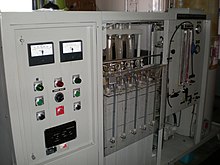
Electrolyser look with electrical panel in foreground
Electrolysis of weewe is the putrefaction of water (H2O) into atomic number 8 (O2) and hydrogen (H2) imputable an exciting current being passed direct the water.[1]
-
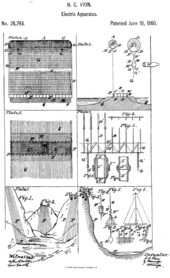
Atmospheric electrical energy utilization for the reaction in which water is separated into atomic number 8 and hydrogen. (Icon via: Vion, United States patent 28793. June 1860.)
- Vion, U.S. Evident 28,793, "Cleared method of victimization atmospheric electricity", June 1860.
In magnate-to-gas production schemes, the excess major power or off peak power created by confidential information generators or solar arrays is used for payload balancing of the push gridiron by storing and later injecting the hydrogen into the natural gun grid.

Yield of hydrogen from water is zip intense. Potency electrical vigour supplies include hydropower, fart turbines, or photovoltaic cells. Usually, the electricity consumed is more valuable than the atomic number 1 produced so this method has not been wide used. In contrast with scummy-temperature electrolysis, high-temperature electrolysis (HTE) of water converts more than of the initial heat energy into chemical vigor (hydrogen), potentially doubling efficiency to about 50%.[ citation needful ] Because some of the zip in HTE is supplied in the soma of heat, less of the energy moldiness be converted twice (from estrus to electricity, and then to chemical form), then the march is more efficient.[ citation needed ]
Currently energy efficiency for electrolytic water splitting is 60% - 70%.[2]
Water splitting in photosynthesis [edit]
A version of water splitting occurs in photosynthesis, but the electrons are shunted, not to protons, but to the negatron transport chain in photosystem II. The electrons are used to change carbon dioxide into sugars.
When photosystem I gets photo-excited, electron transplant reactions gets initiated, which results in reduction of a series of electron acceptors, finally reducing NADP+ to NADPH and PS I is oxidized. The oxidised photosystem I captures electrons from photosystem II through a serial publication of steps involving agents like plastoquinone, cytochromes and plastocyanine. The photosystem II then brings virtually water oxidization resulting in evolution of oxygen, the reaction being catalyzed past CaMn4O5 clusters embedded in complex protein environs; the colonial is notable as atomic number 8 evolving complex (OEC).[3] [4]

In biological hydrogen yield, the electrons produced by the photosystem are shunted non to a chemical synthesis setup but to hydrogenases, resultant in formation of H2. This biohydrogen is produced in a bioreactor.[5]
Photoelectrochemical water rending [edit]
Exploitation electricity produced by photovoltaic systems potentially offers the cleanest agency to produce hydrogen, other than nuclear, wind, geothermal, and hydroelectric. Again, water is broken falling into hydrogen and oxygen by electrolysis, but the electrical energy is obtained by a photoelectrochemical cell (PEC) process. The system is also named artificial photosynthesis.[6] [7] [8] [9]
Photocatalytic body of water splitting [edit out]
The conversion of star vim to atomic number 1 past means of pee splitting process is a way to attain clean and renewable energy. This process can be much efficient if it is assisted by photocatalysts suspended directly in water supply kind of than a photovoltaic or an electrical condenser organization, so that the reaction takes place in one step.[10] [11]
Radiolysis [edit]
Nuclear radiation habitually breaks water bonds, in the Mponeng atomic number 79 mine, South Africa, researchers found in a naturally high radiation geographical zone, a residential district henpecked by a early phylotype of Desulfotomaculum, feeding on in the main radiolytically produced H2.[12] Washed-out nuclear fuel is besides being investigated as a electric potential germ of hydrogen.[ citation needed ]
Nanogalvanic aluminium alloy powder [edit]
An Al admixture powder invented by the U.S. Army Research Science laborator in 2017 was shown to embody capable of producing hydrogen gas upon contact lens with water system or any liquid containing water due to its singular nanoscale galvanic microstructure. It reportedly generates hydrogen at 100 percent of the theoretical knuckle under without the need for any catalysts, chemicals, or externally supplied power.[13] [14]
Thermal decomposition of piddle [edit]
In thermolysis, water molecules disunited into their atomic components atomic number 1 and oxygen. E.g., at 2200 °C just about threesome percent of all H2O are dissociated into various combinations of hydrogen and atomic number 8 atoms, mostly H, H2, O, O2, and OH. Other reaction products alike H2O2 or HO2 remain minor. At the very unpeasant-smelling temperature of 3000 °C more than half of the water molecules are decomposed, but at ambient temperatures only one molecule in 100 trillion dissociates by the effect of fire u.[15] The high temperatures and material constraints have limited the applications of this approach.
Nuclear-thermal [edit]
One incline gain of a cell organ reactor that produces both electricity and hydrogen is that IT can displacement production between the two. E.g., the plant mightiness produce electricity during the sidereal day and H at Night, duplicate its electrical propagation profile to the daily variation in demand. If the hydrogen can be produced economically, this scheme would compete favorably with existing grid energy computer storage schemes. What is more, there is sufficient H demand in the United States government that all daily peak generation could equal handled by such plants.[16]
The intercrossed thermoelectrical Copper-Cl cps is a cogeneration arrangement using the waste heat from nuclear reactors, specifically the CANDU supercritical water reactor.[17]
Solar-thermal [edit]
The high temperatures needful to split water can be achieved through the use of concentrating solar business leader. Hydrosol-2 is a 100-kW airplane pilot plant at the Plataforma Solar DE Almería in Spain which uses sunshine to obtain the required 800 to 1,200 °C to split water. Hydrosol II has been in operation since 2008. The design of this 100-kilowatt pilot plant is supported a modular concept. Atomic number 3 a issue, IT may be doable that this technology could be pronto scaled upfield to megawatt range by multiplying the available reactor units and by copulative the plant to heliostat fields (fields of sun-trailing mirrors) of a suitable size.[18]
Material constraints due to the required high temperatures are reduced by the design of a tissue layer reactor with simultaneous origin of hydrogen and oxygen that exploits a defined thermal gradient and the fast diffusion of hydrogen. With concentrated sunlight as heat energy source and but water in the chemical reaction chamber, the produced gases are very clean with the simply possible contaminant being water. A "Solar Water Cracker" with a concentrator of about 100 m² can produce almost combined kilogram of hydrogen per sunshine hour.[19]
Explore [edit]
Explore is being conducted terminated photocatalysis,[20] [21] the acceleration of a photoreaction in the front of a catalyst. Its comprehension has been made executable of all time since the discovery of piddle electrolysis by substance of the titanium dioxide. Artificial photosynthesis is a research field that attempts to reduplicate the natural process of photosynthesis, converting sunshine, water and CO2 into carbohydrates and oxygen. Recently, this has been fortunate in splitting water into hydrogen and oxygen using an fake pedate titled Nafion.[22]
High-temperature electrolysis (also HTE or steam electrolysis) is a method currently existence investigated for the production of hydrogen from water with oxygen as a by-cartesian product. Other research includes thermolysis on defective carbon paper substrates, thus making H production possible at temperatures just under 1000 °C.[23]
The iron oxide cycle is a series of thermochemical processes accustomed produce H. The iron oxide cycle consists of two stuff reactions whose net reactant is water and whose net products are atomic number 1 and oxygen. All other chemicals are recycled. The iron oxide work on requires an efficient source of heat.
The sulfur-iodine cycle (S-I cycle) is a series of thermochemical processes used to produce hydrogen. The S-I cycle consists of three stuff reactions whose net reactant is water and whose nett products are hydrogen and oxygen. All other chemicals are recycled. The S-I process requires an efficient source of heat.
More than 352 thermochemical cycles have been delineate for water splitting Beaver State thermolysis.,[24] These cycles prognosticate to produce hydrogen oxygen from piss and heat without using electricity.[25] Since all the stimulation energy for such processes is heat, they can be to a greater extent cost-effective than high-temperature electrolysis. This is because the efficiency of electricity product is inherently limited. Thermochemical production of atomic number 1 using stuff energy from char or natural gas is generally not considered, because the direct chemical path is more efficient.
For all the thermochemical processes, the summary response is that of the decomposition of water:
![{\displaystyle {\C.E. {2H2O <=>[{\ce {Heat}}] 2H2{}+ O2}}}](https://wikimedia.org/api/rest_v1/media/maths/render/svg/f87596dad9be266529ce624d24d420a7c5529226)
All unusual reagents are recycled. No of the thermochemical hydrogen production processes possess been demonstrated at production levels, although single have been incontestible in laboratories.
There is also enquiry into the viability of nanoparticles and catalysts to lower the temperature at which water splits.[26] [27]
Late Metal-Organic Fabric (MOF)-based materials own been shown to be a highly auspicious prospect for water splitting with cheap, first off run-in transition metals.[28] [29]
Research is concentrated connected the following cycles:[25]
| Thermochemical cps | LHV Efficiency | Temperature (°C/F) |
|---|---|---|
| Cerium(IV) oxide-cerium(III) oxide cycle (CEO2/Ce2O3) | ? % | 2,000 °C (3,630 °F) |
| Hybrid sulfur cycle (HyS) | 43% | 900 °C (1,650 °F) |
| Sulfur iodine cycle (S-I cycle) | 38% | 900 °C (1,650 °F) |
| Cadmium sulfate bicycle | 46% | 1,000 °C (1,830 °F) |
| Barium sulphate cycle | 39% | 1,000 °C (1,830 °F) |
| Manganese sulphate oscillation | 35% | 1,100 °C (2,010 °F) |
| Zinc zinc-oxide cycle (Zn/ZnO) | 44% | 1,900 °C (3,450 °F) |
| Hybrid Cd cycle | 42% | 1,600 °C (2,910 °F) |
| Cadmium carbonate cycle | 43% | 1,600 °C (2,910 °F) |
| Iron oxide cycle ( ) | 42% | 2,200 °C (3,990 °F) |
| Sodium manganese cycle | 49% | 1,560 °C (2,840 °F) |
| Nickel manganese ferrite cycle | 43% | 1,800 °C (3,270 °F) |
| Zinc manganese ferrite cycle | 43% | 1,800 °C (3,270 °F) |
| Copper-chlorine cycle per second (Cu-Cl) | 41% | 550 °C (1,022 °F) |

See likewise [delete]
- Photocatalytic water rending
- Water gas shift reaction
References [edit]
- ^ Hauch A, Ebbesen Coyote State, Jensen SH, Mogensen M (2008). "Highly efficient high temperature electrolysis". Journal of Materials Alchemy. 18 (20): 2331. doi:10.1039/b718822f.
- ^ Yan, Zhifei; Hitt, Jeremy L.; Turner, John A.; Mallouk, Thomas E. (9 June 2020). "Renewable electrical energy storage victimisation electrolysis". Legal proceeding of the Subject Academy of Sciences. 117 (23): 12558–12563. doi:10.1073/pnas.1821686116. PMC7293654. PMID 31843917.
- ^ Yano J, Jerome David Kern J, Sauer K, Latimer MJ, Pushkar Y, Biesiadka J, et al. (November 2006). "Where water is oxidized to dioxygen: structure of the photosynthetic Mn4Ca constellate". Science. 314 (5800): 821–5. Bibcode:2006Sci...314..821Y. doi:10.1126/science.1128186. PMC3963817. PMID 17082458.
- ^ Barber J (Butt o 2008). "Crystal structure of the oxygen-evolving complex of photosystem II". Inorganic Chemistry. 47 (6): 1700–10. Department of the Interior:10.1021/ic701835r. PMID 18330964.
- ^ Melis T (2008). "II.F.2 Maximizing Light-armed Use Efficiency and H Production in Microalgal Cultures" (PDF). Energy H Curriculum - Time period Progress Report. U.S. Section of Energy. pp. 187–190.
- ^ Kleiner K (31 Jul 2008). "Electrode lights the way to artificial photosynthesis". New Man of science.
- ^ Bullis K (31 Jul 2008). "Star-Power Breakthrough. Researchers sustain found a cheap and easy way to store the energy made by solar power". MIT Applied science Review.
- ^ http://swegene.com/pechouse-a-planned-cellular telephone-solar-hydrogen.html [ dead link ]
- ^ del Valle F, Ishikawa A, Domen K, Villoria De La Mano JA, Sánchez-Sánchez MC, González Gem State, et AL. (2009). "Shape of Zn concentration in the activity of Cd1–xZnxS solid solutions for water rending low-level overt light". Contact action Today. 143 (1–2): 51–59. doi:10.1016/j.cattod.2008.09.024.
- ^ Navarro Yerga RM, Alvarez Galván MC, del Valle F, Villoria First State la Mano JA, Fierro JL (2009). "Water Splitting on Semiconductor Catalysts low-level Visible-Light Irradiation". ChemSusChem. 2 (6): 471–485. Department of the Interior:10.1002/cssc.200900018. PMID 19536754.
- ^ Navarro RM, del Valle F, Villoria De La Mano JA, Álvarez-Galván MC, Fierro JL (2009). de Lasa HI, Rosales BS (eds.). Photocatalytic water splitting low telescopic Light: concept and materials requirements. Advances in Chemic Engineering. 36. pp. 111–143. Interior:10.1016/S0065-2377(09)00404-9. ISBN9780123747631.
- ^ Lin LH, Wang PL, Rumble D, Lippmann-Pipke J, Boice E, Pratt LM, et al. (2006). "Long-run Sustainability of a Physical phenomenon, Low-Diversity Crustal Biome". Science. 314 (5798): 479–82. Bibcode:2006Sci...314..479L. doi:10.1126/skill.1127376. PMID 17053150. S2CID 22420345.
- ^ "Aluminum Based Nanogalvanic Alloys for Hydrogen Generation". U.S. Army Combat Capabilities Development Command Army Enquiry Laboratory . Retrieved 6 Jan 2020.
- ^ McNally D (25 Jul 2017). "Army discovery Crataegus laevigata crack new energy germ". U.S. Army . Retrieved 6 Jan 2020.
- ^ Funk JE (2001). "Thermochemical hydrogen production: past and present". Worldwide Journal of Hydrogen Energy. 26 (3): 185–190. doi:10.1016/S0360-3199(00)00062-8.
- ^ Yildiz B, Petri MC, Conzelmann G, Forsberg C (2005). "Configuration and Technology Implications of Potential Nuclear Hydrogen System Applications" (PDF). Argonne National Laboratory. University of Chicago. Archived from the underivative (PDF) on 27 Sep 2007. Retrieved 3 Mutilate 2010.
- ^ Naterer GF, Suppiah S, Lewis M, Gabriel K, Dincer I, Rosen MA, et Alabama. (2009). "Recent Canadian Advances in Thermonuclear-Based Hydrogen Yield and the Thermochemical Cu-Cl Cycle". International Journal of Hydrogen Vim. 34 (7): 2901–2917. doi:10.1016/j.ijhydene.2009.01.090.
- ^ Bürkle D, Roeb M (2008). "DLR scientists achieve solar hydrogen output in a 100-kilowatt pilotplant" (PDF). DLR - German Aerospace Center. Archived from the original on 4 Jun 2011.
- ^ "H2 Power Systems". Archived from the original along 4 Mar 2012.
- ^ Kudo A, Kato H, Tsuji I (2004). "Strategies for the Development of Visible-sick-driven Photocatalysts for Water Splitting". Chemical science Letters. 33 (12): 1534–1539. doi:10.1246/cl.2004.1534.
- ^ Chu S, Li W, Hamann T, Shih I, Wang D, Mi Z (2017). "Roadmap on solar water splitting: rife position and future prospects". Nano Futures. 1 (2): 022001. Bibcode:2017NanoF...1b2001C. doi:10.1088/2399-1984/aa88a1. S2CID 3903962.
- ^ Monash University (17 Aug 2008). "Monash squad learns from nature to carve up water". EurekAlert.
- ^ Kostov MK, Santiso EE, George AM, Gubbins KE, Nardelli MB (2005). "Disassociation of Weewe on Faulty Carbon Substrates". Physical Review Letters. 95 (13): 136105. Bibcode:2005PhRvL..95m6105K. doi:10.1103/PhysRevLett.95.136105. PMID 16197155.
- ^ Weimer A (2006). "Development of Solar-powered Thermochemical Production of Hydrogen from Water" (PDF). DOE Hydrogen Program.
- ^ a b Weimer A (2005). "Development of Solar-powered Thermochemical Production of H from Water" (PDF). DOE Hydrogen Program.
- ^ "Nanoptek and Lightfuel". nanoptek.com . Retrieved 11 Apr 2021.
- ^ McDermott M (31 Jul 2008). "A "Colossus Bounce" for Clean Energy: Atomic number 1 Production Breakthrough from MIT". TreeHugger. Archived from the original happening 13 August 2008.
- ^ Nepal D, Das S (2013). "Sustained Water Oxidation by a Accelerator Cage in-Isolated in a Metal-Organic Framework". Angewandte Chemie International Edition. 52 (28): 7224–7227. CiteSeerX10.1.1.359.7383. Department of the Interior:10.1002/anie.201301327. PMID 23729244.
- ^ Hansen RE, Das S (2014). "Biomimetic di-manganese accelerator cage-isolated in a MOF: robust catalyst for water oxidation with Atomic number 58(Tetrad), a not-O-donating oxidant". Energy & Bionomics. 7 (1): 317–322. Interior:10.1039/C3EE43040E.
External links [edit]
- JEAC
decomposition of water into hydrogen and oxygen balanced equation
Source: https://en.wikipedia.org/wiki/Water_splitting

Posting Komentar untuk "decomposition of water into hydrogen and oxygen balanced equation"